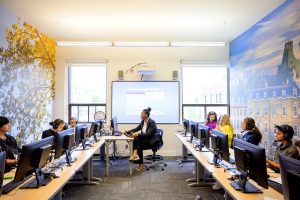
The Akiva School in Montreal, Quebec has unveiled its new foreign language lab, which they are saying is the first of its kind in North America. This lab allows students to practice French using technology either in small groups or one-on-one with the teacher using technology.
Cindy Warren, the assistant head for school advancement said, "The Akiva Language Lab is a unique learning space that enables students to explore languages at their own pace [...] Research tells us that the only way to truly learn a language effectively is through immersion and practice. Statistically, in a traditional classroom setting, each student speaks for less than 20 seconds for every hour of class time."
Warrne and the Akiva School share a huge point, and it's one that all schools should focus on in relation to their language learning classes: students need to spend more time actually practicing the language for it to stick. Anecdotally, I remember spending a significant amount of time conjugating verbs in Spanish class in high school, but I don't remember much of what we leaned (except, of course, for asking where the library is...why does everyone seem to remember "¿Donde está la biblioteca?" anyway?).
I would be curious to see a follow up in 5 years and in 10 years to see how much students' language has improved at the Akiva School and would love to see other schools following suit, spending more time on students making meaningful conversation during class to help make their learning stick.
We have all had the opportunity to use Google Translate at some point in our lives, only to realize that many times it botches the translation we were looking for, or chooses words that would not make sense in the desired language. I'm reminded of a sketch from The Tonight Show Starring Jimmy Fallon, where Jimmy and Anne Hathaway sang songs which were translated out of English into another language and back to English. The results were hilariously terrible:
Now, I am imagining living a life where I have to rely solely on Google Translate, and the certain confusion that would come with using this tool. Sure, Translate gets the idea mostly across, but is it really an effective way to communicate with those around us?
When a student from the University of Texas (UT) saw a new program at the University of California Los Angeles (UCLA) called Project SPELL (Students for Progress in Employee Language Learning), Madelin Chavez was inspired to start the same at UT. This program focuses on university students teaching English to the non-English speaking staff of the university. Chavez grew up in a house with parents who themselves had to learn English, and she saw just how difficult and how vital it was for them.
Through this program, students who are fluent in both English and Spanish are partnered with custodians, maintenance staff, and food service employees whose first language is not English. The students then work with these staff members in a one-on-one setting to improve the employee's English skills. By University estimates, about 60% of the nighttime facilities employees do not speak English as their first language and many work second jobs and are unable to take the time needed to work on their English skills, so this is something that students at the University hope to change.
Larrimie Gordon, the employee engagement program coordinator of Facilities Services at UT found great value in the program and noted, "If we could figure out the logistics part of it, it'd be very beneficial because I have a hard time communicating with folks and letting them know the resources available to them. Google Translate can only do so much, especially if you're talking about more technical stuff like paid leave and the Employee Assistance Program."
I can see such a significant benefit from this program in two directions. First, the obvious one of the English language learner becoming more fluent in English and consequently being able to communicate with more of the people around them and to better be able to self-advocate. The second benefit being to the tutor themselves. When we interact with people we wouldn't have otherwise, we have the opportunity to experience new perspectives; working with these university employees could open the eyes of the college students who might not understand the struggles of a person who doesn't understand or speak the prominent language. Moreover, I could definitely see this program working well in school settings between students, where one student who is fluent in both languages works with a student or students who are learning the second language--many times students learn more from other students than from the teachers (I'm only slightly hurt by this).
Project SPELL and others similar can only bring benefits both for the ELL and for the person tutoring, and I hope that more companies and schools can implement a similar program in their setting as well.
This week, Rosetta Stone announced their new enterprise option of their language learning program made specifically for businesses that deal with international customers. This new program provides tutoring from real people, feedback catered to the user, writing and pronunciation activities, and mobile activity options. Rosetta Stone’s Enterprise program allows users to focus on language and “content that meets [the user’s] needs, such as travel, healthcare, manufacturing, etc.” so that the users can learn and focus on what is most important to their field, rather than learning language that is irrelevant to their position.
I found a few features of this new version of Rosetta Stone very impressive and I am hopeful to see these features make their way into the classroom version of the program if they haven’t already. First, their “TruAccent ® Speech Recognition Engine” which uses AI and machine learning to compare user’s pronunciations to “thousands of hours of recorded speech data.” This data is compiled through the machine learning to recognize what natural language sounds like in the language being learned. In the classroom, we want our students to be learning their desired language without the frustration of trying to perfectly match the pronunciation of the computer (something I dealt with and was frustrated with when I used the program in high school). Another feature I could see great use for in the classroom is the “Seek & Speak” function which tasks the user to find everyday objects with their mobile device and point the camera at the object. Seek & Speak then uses augmented reality (AR) and object recognition to identify the objects, translates the name of the object into the desired language, and then has the user practice speaking using the new vocabulary they learned. I’m imagining how memorable this would be to our students using this activity--it would get students up and out of their seats, making real-world connections, and then immediately practicing (GlobeNewswire, 2019).
I really am impressed to see how far Rosetta Stone has come in the last decade. It truly can be a huge asset to businesses and districts that do not currently have the resources to teach a lesser-spoken language (there are plenty of teachers who can teach Spanish to English speakers, or vice versa...but how many English speakers who can teach Bulgarian?). The program has also made huge improvements in how it teaches, providing a learning experience curated for each student individually to give them the help they need the most. Rosetta Stone is a wonderful resource that can and should be used to help assist in learning a second language.